
21 Years Later: My Own Personal Zombie Movie
Over two decades after the 7/7 bombings in London, I remember where I was and what I did on that fateful day.

Twenty-one years ago today, I lay in a bed at Charing Cross Hospital, my body waging war against a vicious kidney infection, tethered to an antibiotic drip. Two days into my stay, I thought the worst pain was the fire in my kidneys. Then came 7th July 2005, a day that changed London forever.
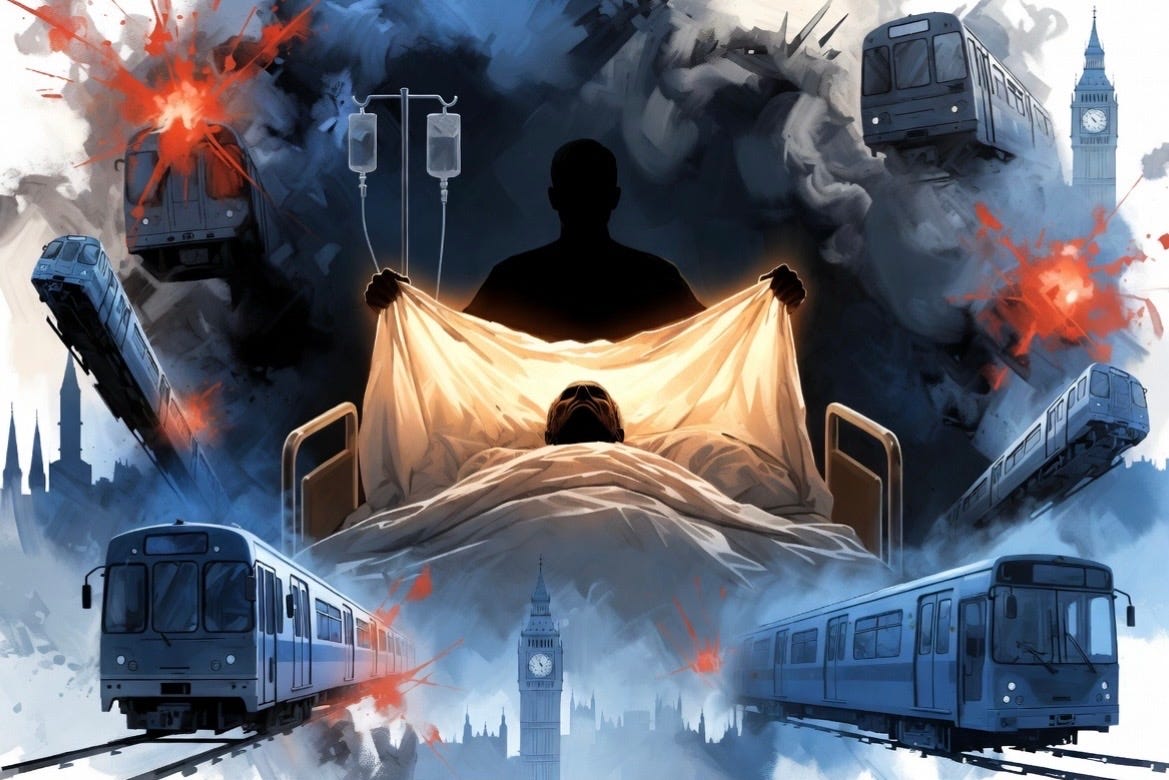
I didn’t know at first. My first inkling of the disaster was that the nurses seemed distracted. More patients and staff than usual passed the ward door seemingly heading towards the room that housed the ward TV.
I clambered out of bed and, making sure I didn’t disconnect my drip, walked slowly, wheeling the contraption with me as I left the ward. There was an air of something different but I couldn’t say what. I stopped at the doorway of the TV room and, seeing a news bulletin, quickly worked out what had happened. The words ‘bombs, ‘London Underground’, ‘bus’, ‘dead’ rattled in my head as I made my way back to my bed.
There had been four coordinated attacks only a hour before - three on the Tube, one on a Tavistock Square bus - bomb blasts ripping through central London’s morning rush. I didn’t know then but discovered later that 52 lives were snuffed out that day, hundreds more maimed. The city had been left reeling. The 7/7 bombings, as we soon came to know them, weren’t just an attack; they were a wound on our collective soul.
In Charing Cross hospital, panic spread like wildfire. “Evacuate!” a nurse barked, her voice sharp with urgency. “If you can walk, go NOW!” The hospital, too close to the carnage, was no longer safe. The walking wounded - crutches clicking, IV poles rattling - stumbled toward the exits. Those too frail, too broken, stayed behind, their eyes wide with fear, abandoned to an uncertain fate. It was a scene of apocalyptic despair, the kind you’d expect in a disaster film
In the bed beside mine was an elderly man. He was quiet, his hands trembling under a thin sheet. The day before, he’d whispered his story: a brutal racist attack while fetching his Sunday papers, leaving him bruised in body and spirit. Now, as the ward descended into chaos, he looked smaller, colder, his fear palpable. I couldn’t leave him like that. He had one leg in traction, an arm in plaster. I pulled the cannula from my arm, saw the blood beading before I pressed down hard on it with a bedsheet to stop the flow. I yanked the blanket off my bed and tucked it around him. “Don’t worry,” I said, hoping my voice carried more conviction than I felt. “You’ll be OK.” His eyes met mine, grateful but haunted.
I turned to a nurse, her face a mask of controlled panic, and asked if I could stay to help. “Just GO!” she snapped, her words like a shove towards the door. I glanced back at the old man, cocooned in my blanket and hoped it would shield him from more than just the cold. Then I hobbled out, my infection screaming with every step, into a city unravelling.
Fulham Palace Road was a tableau of the lost. People staggered, faces blank, eyes and minds searching for explanation. Mobile networks were down, choked by panic or design. Traffic stood still, cars abandoned like relics of a world that had ended an hour ago. It was as if London had become the setting for an apocalyptic movie - zombies replaced by the shell-shocked. I staggered along, searching for a payphone. I found one in the foyer of the King Street cinema. I called my partner in Chiswick. It took him nearly an hour to crawl those few miles. I’d have walked but I was in too much pain so I simply slumped into sitting position on the pavement outside the cinema.
We ended up at Pizza Express on Chiswick High Road, an absurd refuge in a world gone mad. I noticed the hospital wristband still clinging to my wrist. It was a relic of the ward, of the elderly gentleman in the bed next to me, of a day that had broken us all.
Around us, diners whispered about bombs, about death tolls, their voices low, as if speaking too loudly might summon more horror.
Twenty-one years on, 7/7 remains a scar on London’s psyche. Many of us have questioned the attack in that time, wondering who was truly responsible. Many believe it was a psy-op, another false flag. But none of that crossed my mind on the day. Looking back now, I mostly remember that old man, battered by prejudice yet clinging to dignity, and to the blanket I left him. In that moment, it was all I had to give.
Today, as we mark this grim anniversary, I’m reminded that even in our darkest hours, it’s these small acts - blankets, words, fleeting connections - that keep us human. It’s important that, regardless of what happens and no matter who does what, we remember that.
There was a good article on this sad day in our history that helped me understand what truly happened. Needless to say, this event was home brewed and not by the men the msm spoke of.
Have you seen this video?
https://youtu.be/R7PQG5weeHk?is=avu8JzW-XqNK_XMf